MRES Science Olympiad Team

A Triumph Built on Collaboration and Passion for Science
The Monarch Science Olympiad team recently competed at the San Diego and Imperial Regional Competition on February 7, 2026. Working together, they proudly earned the first‑place trophy! This year, 73 students (six teams) participated in 15 events, supported by 14 parent coaches of participating students, and four high‑school student coaches. It was this tremendous collaborative effort and the dedication shown by everyone involved that lifted them all the way to the top of the podium. While elementary students (Division A) compete only at the regional level, it is a nationwide competition in which the winning teams of the middle and high school divisions advance to state and national tournaments.
Classes (or preparation for the competition) start around September and continue through the regional tournament, which typically takes place in February. During these five to six months, students attend weekly evening classes—one to a few one‑hour sessions depending on the number of events they are preparing for. Any 4th‑ or 5th‑grade student may join after completing registration. However, students will be challenged to explore topics in depth, often well beyond typical grade‑level expectations. Because of this, participants are expected to stay committed through consistent self‑study and practice. Currently, 3rd graders are accepted only through teacher referral and informal assessments in order to ensure they are prepared to keep up with the program’s academic rigor.


The Spirit of the Science Olympiad
One of the core values of the Science Olympiad is developing students’ collaboration and problem‑solving skills. The competitions are intentionally designed to challenge different types of scientific thinking, generally falling into three categories: conceptual knowledge, process skills, and engineering design and construction. Events span the major fields of science, including earth science, biology, chemistry, physics, and engineering. Each competition event is crafted to mirror real‑world scientific practice. Another unique component of the Science Olympiad is that teamwork plays a central role in the competition. Students compete in pairs, which requires them to communicate and collaborate effectively under pressure, and work together toward shared goals.
Days of Training
In the MRES Science Olympiad team, the coaches ensure that their practice reflects the spirit and purpose of the Science Olympiad. At the beginning of the season, partners are intentionally assigned completely at random. Students often start out as strangers, but from that moment on, they learn to collaborate, communicate, and solve problems together. The coaches strongly believe that these skills will continue to matter throughout their education and later in their careers.
Throughout the season, students were regularly challenged with advanced concepts and encouraged to deepen their understanding through self‑study. For example, in preparation for the knowledge‑based events, they were guided to explore topics more thoroughly—learning not just the facts, but the underlying concepts and the proper use of scientific terminology. This level of mastery simply cannot be achieved through test‑cramming; it comes from steady curiosity, learning, and genuine engagement with the material.


The coaches also embody the philosophy of hands‑on science in their teaching. For example, during preparation for the “Tower Power” event—where students compete by building the strongest and tallest tower from straws and marshmallows—coaches could simply teach the optimal winning design. Instead, they invite students to build a variety of three‑dimensional structures—such as cubes, cylinders, cones, and pyramids—and test them one by one, allowing students to learn through experimentation and comparison to understand why certain designs work better than others. The coaches emphasize that this mirrors the true scientific process of trial and error, helping students cultivate creativity and critical thinking skills.
On the Day of Competition
On the day of competition, participating in the Science Olympiad gives students unique and memorable experiences in so many ways. For many students, simply walking onto a college campus is a first‑time thrill. Dozens of tents—representing each school—line the large campus courtyard, creating an impressive and energizing scene. The competition itself operates under strict codes: students must follow detailed rules, navigate “participants‑only” restricted areas, and communicate independently with judges. This formal environment and intensity give students a strong sense of responsibility and maturity.
Yet even with all the seriousness, they never forget to have fun. After each event concludes, students often relax together, running across the field, chatting with teammates, and soaking in the excitement and festival‑like atmosphere. It’s a day that blends challenge, pride, and pure joy.


What Students Gain from Participating
The heart of the Science Olympiad is exploration, discovery, and cultivating a genuine love for science, not memorization or competition. The program is made rigorous in order to elicit active participation from students and challenge them to learn beyond what they are taught in the classroom. Through their hard work, they begin to understand why science matters and how it connects to real‑world problem‑solving. More than anything, the true value of their experience was written across the children’s faces on the day of the competition, glowing with satisfaction, excitement, and pride as they watched their hard work pay off.
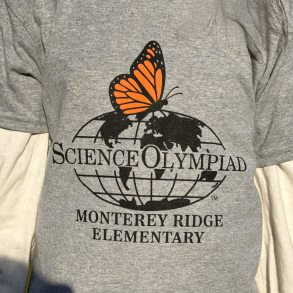
About the MRES Science Olympiad Team
The MRES Science Olympiad team is an independently funded organization, to which MPTF does not provide financial sponsorship. Instead, MPTF supports the team with essential logistics, as official school representation is required to participate in the competition. The program was founded in 2024 by Megha Patil, Neeta Parimi, and Ashwin Mantravadi—two parents and one high‑school volunteer—whose vision and dedication launched this opportunity for Monarch students.
The team welcomes motivated 4th and 5th grade students who love science, enjoy collaborating with teammates, and who are eager to challenge themselves with science that goes beyond typical elementary‑school explorations. Registration opens at the beginning of each school year, and the season concludes with the regional competition. Parent involvement is highly encouraged, whether as coaches, assistants, or behind‑the‑scenes supporters. No professional scientific or teaching background is required—just enthusiasm, curiosity, and a willingness to cheer students on as they explore and grow.
For questions or to learn more, please contact mresscioly@gmail.com.